 ユーザー登録
 ログイン


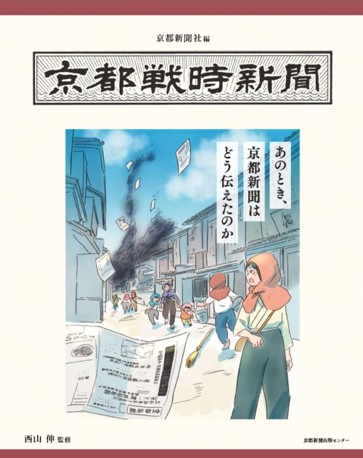
The Kyoto Shimbun has published "Kyoto Wartime Newspaper" - a collection presented in the format of full-sized, reprinted newspaper pages. It is a compilation covering the period from the outbreak of war in December 1941 to the immediate aftermath of Japan’s defeat in September 1945. The paper quality is far superior to that of the original, the fonts use modern characters rather than the old ones, and the type size is larger - making it far easier to read than the newspapers of that era. Yet the headlines from the day the war began, such as “ ‘Annihilate Them!! The World’s Enemies, the U.S. and Britain’ - Now Is the Time to Die for the Nation in This Time of Crisis’ that leapt off the page in large type, as well as headlines from the fourth year of the war, when war-weariness was setting in - such as “Life in Air-Raid Shelters Can Be Enjoyable with a Little Ingenuity” - convey a real sense of the era.
The year 2025 marks the 80th anniversary of Japan’s defeat. A team of 12 young reporters - in their 20s to 40s - spent a year preparing this project. These reporters belong, in effect, to the generation of the grandchildren of those who lived through the war; with survivors now over the age of 90, opportunities to hear firsthand accounts have become rare. While many media outlets produce special features at the end of the war, I am unaware of any other instance where a news organization has looked back at its own wartime coverage to document the "mistakes made by the newspaper company." To truly reflect on the mistakes of their predecessors - who engaged in propaganda reporting to stoke the will to fight - these young journalists must recognize the continuity of the media they now represent across the prewar, wartime, and postwar eras, and cultivate a sense of belonging to that institution. The Kyoto Shimbun’s stance - in which young reporters with no firsthand knowledge of the war conceived such a project and carried it out as an organization - is worthy of respect. The pages contain not only reprints of articles from that era but also accounts, viewed from today’s perspective, of the killings of civilians by Japanese soldiers during the Battle of Okinawa and women’s wartime cooperation, which was rooted in misogyny.
Newspapers are instruments of propaganda - in other words, they are instruments of brainwashing. “This newspaper was not merely a victim of censorship and pressure from the military. It was also a perpetrator that incited readers and drove them toward war,” the book states. Shin Nishiyama, who wrote the commentary, makes an intriguing observation. Having understood that “once the war had reached its desperate stages, media reports emphasizing the enemy’s cruelty - such as referring to the ‘beastly Americans and British’ - began to increase,” Nishiyama notes that, compared to national newspapers like the Asahi Shimbun, the Kyoto Shimbun “hardly ever carried such fanatical articles inciting hostility.” Come to think of it, not only did Kyoto escape air raids, but its people may also have been indifferent - or even cold - toward a war waged in the name of the "Emperor." I have seen data from a 1990s public opinion poll indicating that Kyoto, along with Okinawa, had the lowest level of affection for the Emperor. While one can certainly understand the sentiments of Okinawa - which was effectively sacrificed as a "disposable shield" - Kyoto is a place that has endured the repeated rise and fall of various power brokers throughout its history. There is a certain resilience there - a refusal to be swayed by any authority. That said, there are accounts suggesting that Kyoto residents - who had maintained their daily lives even during the war - were largely unmoved by the shock of defeat and were extremely cold toward those who returned from Manchuria after the war with nothing but some clothes on their backs. It would be fascinating to compare the wartime records of various regional newspapers.
Does the commitment to "confronting past errors - namely, cooperating with wartime press controls and failing to report the true state of the war or the reality of air-raid damage - as a modern media organization" still hold true today? Is there any deference or self-censorship toward a government that holds an overwhelming majority? One must not forget that reflecting on the past should serve as a catalyst for self-examination in the present.
Published in column “Ten’gan” (The Mind's Eye), "Kyoto Shimbun" on June 14, 2026 (reprinted with permission)
The original article was written in Japanese.
https://wan.or.jp/article/show/12509
Click here to order the book.
https://books.kyoto-np.co.jp/book/b10159584.html