
 ユーザー登録
 ログイン
ログイン
Image by Sekai:https://websekai.iwanami.co.jp/posts/9748
Whenever I’ve been asked to comment on the imperial system, I’ve declined. The more it was discussed, the more I feared that the debate—both for and against—would draw public attention. Instead, I felt it would be better for interest to gradually wane and for the imperial line simply to fade away when it came to an end.
Now, the continuity of that imperial line is in jeopardy. Aside from Crown Prince Akishino, the only male-line heir to the throne in the next generation is his son, Prince Hisahito. By stoking a sense of urgency—that amending the Imperial House Law cannot wait—efforts are underway to pass an amendment during the current session of the Diet. The proposal offers two options: strictly adhere to succession by male descendants in the male line, or allow a female emperor. The former would create an adoption system for male descendants of the imperial line, while the latter would allow female members of the Imperial Family to retain their status after marriage. Both approaches could also be adopted.
Another last-resort option for expanding the pool of potential heirs to the throne is the concubine system. Ancient emperors had female court attendants and consorts known as uneme, and Emperor Meiji had two principal consorts and five concubines, with a total of 15 children (1). It was not until the reign of Emperor Taishō that emperors ceased to have concubines. Some conservatives argue that male-line succession can be maintained only through a concubine system, but this option is prohibited under modern civil law, which bans polygamy. Neither domestic nor international public opinion would be likely to tolerate it.
Conservative political parties remain adamantly committed to male-line succession, while the Japan Innovation Party and the Democratic Party for the People both take an ambiguous middle-ground position leaning toward acceptance of a female emperor; the centrist parties, unable even to reach a consensus, later came to advocate accepting a female emperor. The centrists champion “equality under the law,” yet the imperial system itself fundamentally contradicts that principle. Even the Communist Party, which once advocated abolishing the imperial system, now calls for accepting a female emperor. When exactly did it switch to supporting the imperial system?
Many historians have long maintained that male-line succession is not a Japanese tradition at all, but rather an “invented tradition” dating back to the Meiji era (2). Despite the emergence of the first female prime minister in Japan’s constitutional history, we now face the irony of that very prime minister taking the lead in insisting on male-line succession (3).
The Imperial System and the Japanese Family System
Both adoption and the loss of imperial status by female members of the Imperial Family are rooted in the traditional Japanese family system. It is well known that Japanese families have been maintained not on the basis of blood ties but as organizational units managed by their members. This family system incorporates non-relatives into fictive family relationships (such as those between master and disciple or sworn brothers); in this sense, Japanese families differ from the kinship-based family systems found on the continent. Adoption has helped sustain these flexible family structures.
On the other hand, the loss of imperial status by female members of the Imperial Family upon marriage is also based on patrilineal kinship. A daughter who “becomes a member of another family upon marriage” changes her affiliation by taking a new surname. A surname signifies the affiliation of children born of the marriage; children who inherit their father’s surname therefore belong to their father’s clan. This is because a child is regarded as the most important outcome that marriage can bring a family. For a long time, divorce for a woman meant leaving her children with her in-laws and departing alone. Consequently, fear of separation from her children deterred women from divorcing. Yet the father did not raise the children left behind in a single-father household. Under this family system, the paternal side was able to exercise sole parental authority for so long precisely because the father’s parents and sisters could provide childcare.
Sole parental authority shifted rapidly from fathers to mothers in the 1960s. This coincided with the rise of the nuclear family, a decline in the proportion of three-generation households, and the onset of an era in which families could no longer rely on grandparents for childcare support. Although few Japanese fathers—either before or after that time—could be said to have taken an active role in raising children, “joint parental authority” was nevertheless written into law the year before last.
This patrilineal principle of descent was explicitly enshrined in the Nationality Law until it was amended in 1985. Under the previous law, children born to a Japanese woman and a foreign man automatically acquired their father’s nationality. Conversely, children born to a Japanese man and a foreign woman acquired Japanese nationality. In 1985, in preparation for ratifying the UN Convention on the Elimination of All Forms of Discrimination against Women, the Diet amended this gender-asymmetrical law. It is clear, however, that the previous Nationality Law was based on the principle of clan affiliation under the traditional family system.
Viewed in this light, it becomes clear that those who cling to the principle of shared surnames for married couples are seeking to preserve the patrilineal family system. They likely wish to maintain gender discrimination.
Gender Asymmetry in the Imperial Family
Both adoption and the retention of imperial status by female members of the Imperial Family raise a number of further questions. If adoptees were drawn from former branches of the Imperial Family, how close would the required degree of kinship be? Are there any eligible candidates in the first place? Even if there were, could their consent be obtained? Furthermore, could someone who had previously been a private citizen be prevented from using his new position for political or commercial purposes? House of Representatives Speaker Eisuke Mori, whose role is to forge a “consensus of the legislature,” faced a backlash after boldly stating that although an adopted son would not be eligible to succeed to the throne, his child could. Yet this would be a natural consequence of permitting male-line adoption. Male members of the Imperial Family would then be treated as little more than stud horses. Female members of the Imperial Family are likewise pressured to bear sons, effectively reducing them to “baby-making machines.” It is well known that those around the current Empress drove her into a corner because her only child was a daughter.
When it comes to retaining imperial status, the key question is whether the spouses and children of female members should also be granted such status. Historically, when a male member of the Imperial Family married a commoner, his spouse and children became members of the Imperial Family. When a female member married a commoner, however, her spouse did not—a clear case of gender asymmetry. Furthermore, a commoner spouse without imperial status cannot be prevented from engaging in political activities, such as running for office. To begin with, the fact that marriage to a commoner does not affect a male member’s imperial status but causes a female member to lose hers is itself sexist. Conversely, if legislation allows female members of the Imperial Family to retain their status, they will lose the freedom to renounce it through marriage. We witnessed the media switch overnight from “Princess Mako” to “Ms. Mako Komuro” when Princess Mako, the eldest daughter of the Akishino family, married Kei Komuro. Princess Mako could not have gained her freedom without “fleeing” abroad.
As things stand, the next generation has only one male heir to the imperial line: the eldest son of the Akishino family. There are two female heirs: the eldest daughter of the Imperial Family, Princess Aiko, and the second daughter of the Akishino family. If these two women leave the Imperial Household through marriage, the pool of candidates will shrink even further. Their opportunity to leave before the legislation is enacted is rapidly slipping away.
The Tension Between Conservatives and Liberals
Regarding amendment of the Imperial House Law, a peculiar tension has arisen between conservatives who insist on male-line succession and liberals (if they can truly be called that) who accept the possibility of a female emperor. Conservatives claim to revere the Emperor, yet by narrowing the pool of potential successors, they are helping to hasten the imperial system’s decline. Conversely, by advocating gender equality within the imperial system, liberals are actually helping to prolong its existence. Some conservatives even go so far as to say, “The Emperor doesn’t need to do anything” or “The Emperor has no human rights.” They may wish to preserve the institution, but they do not appear to revere the Emperor as a person.
It is strange that the Imperial House Law is being amended without any input from the people directly affected. Before his abdication, the Heisei Emperor announced in a televised message that he wished to step down during his lifetime. In doing so, he sought to depart from the existing Imperial House Law, which provided no mechanism for a living emperor to abdicate; backed by public opinion, he secured a special exception to the law. The Emperor himself breached the norm barring him from political acts, and his wish to step down during his lifetime also sparked controversy. The government could have disregarded the message as a departure from the Constitution. Yet it demonstrated the Emperor’s considerable power to mobilize public opinion.
The Heisei Emperor—that is, the current Emperor Emeritus—most likely took this unusual step because he had learned from Emperor Shōwa’s death. Having witnessed firsthand how repeated calls for public self-restraint only intensified dissatisfaction and backlash, he must have resolved not to repeat that mistake. If anyone could be called the “producer” of the imperial system—whether the Emperor Emeritus himself or the wise Empress Emerita—I believe this was a truly astute strategy.
Public Interest in the Imperial System
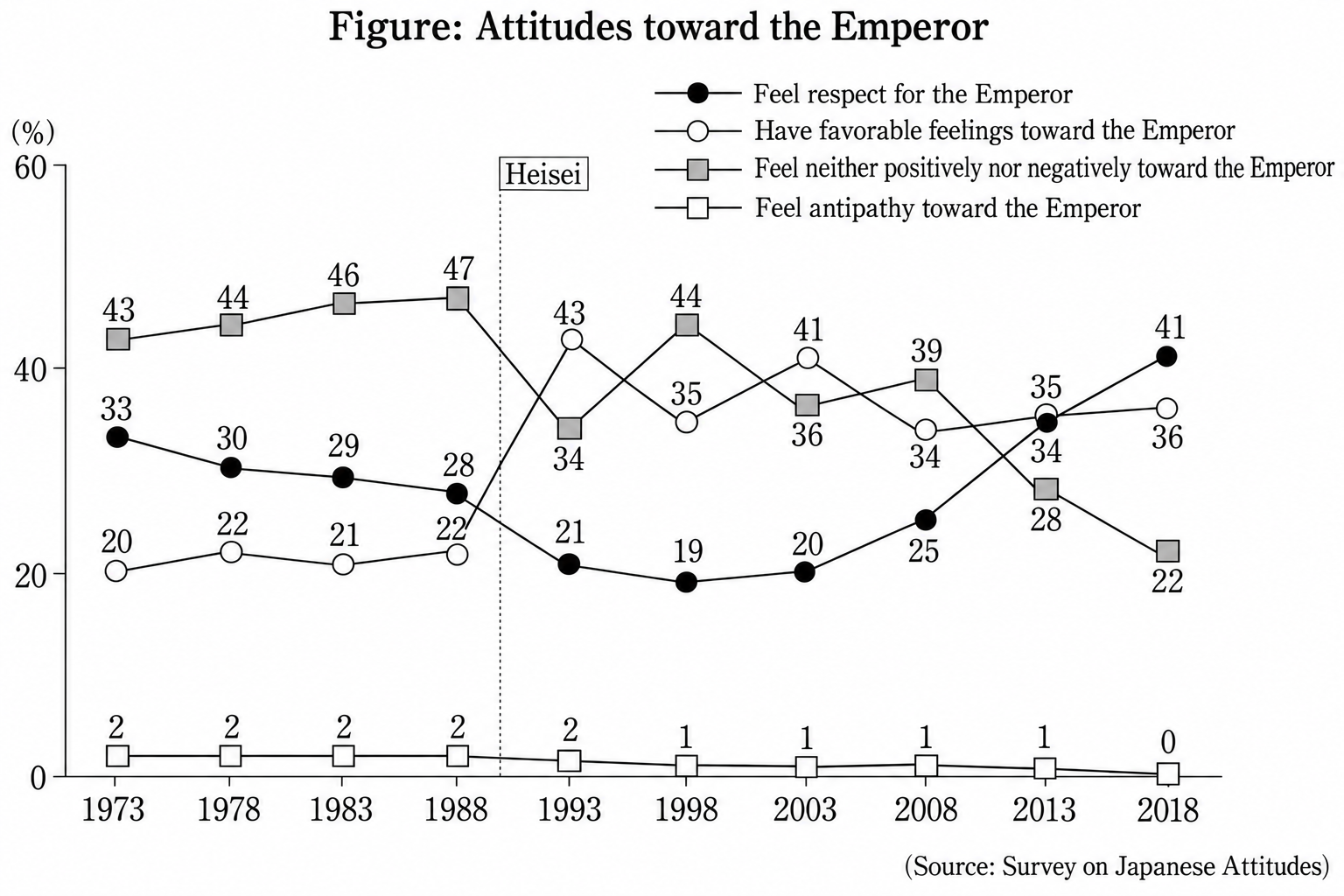
Eighty-one years after the end of the war and eighty years after the promulgation of the new Constitution, public opinion of the Emperor has changed with the times. Yet there is arguably no reliable dataset that consistently tracks postwar changes in such measures as interest in and support for the imperial system or the public’s sense of familiarity with the Emperor, because the questions asked in opinion polls have varied. Let us therefore examine the reliable NHK Survey on Japanese Value Orientations, conducted since 1973 (4) (Figure).
Although these data go back only to 1973, interest in the imperial institution has steadily declined since the end of the war. The younger the generation—that is, the more recently its members were born after the war—the less interest they show. My hope that interest would simply fade away was therefore not entirely unfounded. Beginning around the 1980s, the aging Emperor Shōwa was portrayed by the media as the “Emperor of Peace,” described by overseas scholars as an “empty center” (5), and even idolized as “the cute emperor of young girls” (6).
Interest in the Emperor surged during the transition from the Shōwa era to the Heisei era. Daily newspaper reports of Emperor Shōwa’s intestinal bleeding inevitably heightened public interest, but they actually diminished the respect people felt for him. Many must have looked at the city’s extinguished neon lights and wondered, with frustration, why the public had to refrain from concerts and parties simply because it was being taken on the emotional roller coaster of one elderly man’s health deep in the forests of Chiyoda.
Even earlier than that, in the immediate aftermath of Japan’s defeat, public interest in the Emperor was largely negative. Among the common people, who had been unwillingly mobilized for a war waged in the Emperor’s name, resentment and hatred toward the Emperor were running high. While some citizens shed tears of shame in front of the Imperial Palace upon hearing the Imperial Rescript on the Termination of the War, it is clear from public opinion at the time that an even greater number of people believed the Emperor should abdicate and that the imperial system should be abolished.
Michio Kimura, a farmer-poet living in the Tohoku region, recorded “My Grandmother’s Song,” in which she expressed her grief over losing her two sons in the war.
“Why is Japan’s Hinomaru red? It is red with my sons’ blood, never to return (7)”
Reading this, one can understand the feelings of those who cannot remain indifferent to the national flag. In today’s terms, would describing the red of the Hinomaru as the color of a son’s blood constitute verbal “desecration of the national flag”?
Those same people enthusiastically welcomed Emperor Shōwa on his regional tours several years after the war ended. The occupying forces and the Imperial Household Agency orchestrated these tours, during which the Emperor traveled extensively through all 46 prefectures except Okinawa. It is well known that the occupying forces skillfully made use of the Emperor’s sovereign authority and the prewar bureaucracy. They placed the blame on the military leaders—headed by General Hideki Tojo—who had “assisted” the Emperor, executed them after the Tokyo war crimes trials, and absolved the Emperor of any responsibility for the war. Among the leaders of the countries involved in World War II—a war against fascism—Italy’s Mussolini was executed, Germany’s Hitler committed suicide, and Japan’s Hirohito alone was not held accountable.
Emperor Shōwa, who toured the scorched wasteland left by Japan’s defeat aboard an imperial train bearing the chrysanthemum crest, was enthusiastically welcomed wherever he went with small Japanese flags and lantern processions. Although the Japanese mainland had not become a ground battlefield, the Emperor must have witnessed firsthand the devastation caused by the air raids. There were undoubtedly would-be assassins, yet the tours actually helped prolong the life of the imperial system (8). Confronted by the reverence and enthusiasm of ordinary people across the country, the occupying forces must have been struck by how deeply rooted the imperial system was. A people’s historian called this the “grassroots imperial system,” or the “imperial system of every tree and blade of grass” (9).
The depth of the imperial system’s roots is also evident in a later episode involving a visit by the Minister of Health and Welfare to the hospital room of a Minamata disease patient. Suffering terribly from pollution caused by the state-sponsored company Chisso, the patient reportedly cried out from his bed, “Long live His Majesty the Emperor!” (10). This, however, expressed hope in a transcendent power that might save him; it was by no means a feeling of affection.
Yet even that divine power holds no sway over those born after the war.
The Emperor as “Guardian of the Constitution”
During the reign of Emperor Akihito in the Heisei era—he is now the Emperor Emeritus—feelings of affection toward the Emperor rose rapidly. While Crown Prince, Akihito married the commoner Michiko Shoda, who became Crown Princess. He took no concubines and embodied the modern monogamous family, becoming a national idol. Wishing to raise her children herself, the commoner Crown Princess declined to employ a wet nurse, and women’s weekly magazines ran photo spreads on her lifestyle and fashion. The Heisei Emperor and Empress’s strategic presentation of the imperial institution had a profound impact. On their own initiative, they visited battle sites in Japan and abroad to offer deep condolences, and whenever disaster struck, they immediately traveled to the affected areas to comfort the victims. It must have been the first time the public had seen an Emperor kneeling before disaster victims. Thanks to the Heisei imperial couple, the image of an Emperor who “prays for peace and the well-being of the people” became firmly established.
The Heisei Emperor repeatedly declared, “I will uphold the Constitution,” whenever the occasion arose. This was only natural, since the basis of the Emperor’s status lies in Article 1 of the Constitution. “Upholding the Constitution” also implied upholding the “peace constitution.” When the Act on National Flag and Anthem was enacted in 1999, the Emperor reportedly remarked at a garden party, “I hope it will not be made compulsory.” Consequently, even the liberal left came to regard the Emperor as a guardian of the Constitution. In a recent book, Koichiro Kokubun described this in the somewhat sensational phrase “Defeat by the Emperor” (11). He was referring to the “twist” whereby “the Emperor—whose very existence is grounded in Article 1—supports constitutionalists seeking to defend Article 9 to the end.”
The data show that the conduct of the former Emperor and Empress won public affection for the imperial system, but since the Reiwa era began, both interest and affection have waned. For today’s younger generation, the imperial system is simply something that has always existed. With their classic imperial style, members of the Imperial Family cannot become fashion leaders or idols. Features on the Imperial Family were long a surefire topic for women’s weekly magazines, but that appeal has likely faded. Opinion polls show a recent slight increase in interest in the imperial system, probably because of media attention surrounding amendment of the Imperial House Law. The more the system is discussed—whether in support or opposition—the more interest it attracts. There is a reason I felt that “it’s better not to speak of it at all.”
For the postwar generation, which views the imperial system as a form of traditional cultural heritage, the remaining question is probably whether its cost is commensurate with its benefits. The cost of maintaining the imperial system amounts to 12.6 billion yen for the Imperial Household Allowance, 13 billion yen for the Imperial Household Agency’s operating expenses, and, when security costs are added, approximately 34 billion yen annually (FY 2025).
Human Rights of the Imperial Family
Do members of the Imperial Family have human rights?
They have neither freedom of occupational choice nor freedom of movement. Their privacy is monitored, and they are effectively caged birds. If democracy were simply a matter of majority rule, minorities would always be forced to submit to the majority’s will. People with disabilities are a minority, yet the international disability rights movement has long championed the slogan “Nothing about us without us.” Members of the Imperial Family constitute an even smaller minority, yet amendments to the Imperial House Law are being proposed without their voices being heard at all.
Constitutional scholars refer to the imperial system as an “enclave” of human rights—in other words, an “exception.” It makes perfect sense for them to argue that before advocating gender equality in imperial succession in the name of “women’s human rights,” we must first eliminate this “enclave” (12). Yet the very concept of human rights admits no exceptions, nor should it. Fundamental human rights are “natural rights”: they do not require a guarantee by the state or by law but exist prior to both. That is precisely why they are called “innate human rights.”
The imperial system is built on disregard for the human rights of the Imperial Family. The suffering it has caused its members is evident in the former Empress’s loss of speech due to stress and the current Empress’s adjustment disorder. The media reported the decisive words the current Emperor used when proposing to the Empress: “I will protect you with all my strength for the rest of my life.” Yet, as the Emperor himself later acknowledged at a press conference—“There were also developments that seemed to deny Masako’s very identity”—he was unable to keep that promise.
The Emperor as the Source of Authority
However, this minority consists of a privileged few. Their livelihoods are guaranteed by the people’s tax dollars, and they function as the source of authority. The Diet cannot convene without being summoned by the Emperor, and neither the Prime Minister nor cabinet ministers can be appointed. Indeed, the Japanese term for prime minister, sōri-daijin, derives from the “daijin” (minister) of the Ritsuryō system. The “ministers” of each ministry remain subjects of the Emperor to this day.
This authoritarian order, which creates class distinctions among the people, runs counter to the principle of equality. Although distinctions among the nobility, the samurai class, and commoners were abolished after Japan’s defeat in World War II, the Imperial Family alone remained a privileged class. The Emperor is the source of authority. One’s rank—First Class, Second Class, and so on—is determined by one’s distance from that authority. When former U.S. Air Force General Curtis LeMay—who had led strategic bombing raids on Japanese cities during the war—was awarded the Grand Cordon of the Order of the Rising Sun, many citizens were stunned.
The government skillfully manages the system of honors. Twice a year, in spring and fall, approximately 9,000 people—both famous and unknown—receive decorations ranging from the Supreme Order of the Chrysanthemum to the Orders of the Rising Sun and the Sacred Treasure, based on their contributions to the nation. For cultural figures, there is the Order of Culture. Looking at the list of recipients, one is impressed by the thoroughness with which even grassroots figures are recognized. The government does not cover travel expenses for attending the investiture ceremony presided over by the Emperor. Recipients must cover all expenses themselves—including bringing a spouse, having a morning suit or formal kimono tailored for the occasion, and hosting a celebratory reception after the ceremony. I’ve seen the actual medals before; they were cheap-looking trinkets that didn’t cost much to produce. Given that people are so deeply moved just by receiving such a tiny token, it’s a highly cost-effective government initiative.
I’ve heard that people rarely decline an honor, but some prominent figures in Japan have done so. Because the Imperial Household Agency does not publish a list of those who have declined honors, the exact number cannot be confirmed. Based on their own disclosures, however, Nobel Prize-winning author Kenzaburo Oe, as well as Saburo Shiroyama, Haruko Sugimura, Yoshio Nakano, and Shunsuke Tsurumi, all declined decorations.
The imperial system is thus a source of authoritarianism—indeed, it can be described as the very embodiment of a patriarchal system heavily skewed toward patrilineal principles. The patrilineal family system, supposedly abolished by the new Constitution, has survived with the Imperial Family as an exception. As long as it is held up as the model for Japanese families, any discourse of equality will ring hollow. Above all, double standards—including class distinctions—will persist under Japan’s legal system.
The Mystery of “Preserving the National Polity”
In 2024, the United Nations Committee on the Elimination of Discrimination against Women (CEDAW), in its “recommendations” to the Japanese government, called for revision of the Imperial House Law as well as the introduction of separate surnames for married couples. The blatant gender asymmetry of male-line succession had been recognized as gender discrimination even by international standards. In response, however, Japan’s Ministry of Foreign Affairs immediately took punitive action. Treating CEDAW’s recommendation as interference in domestic affairs, the government responded in a manner reminiscent of the Trump administration by suspending Japan’s financial contributions to CEDAW. It soon emerged that the Japanese government was already in arrears, producing the embarrassing spectacle of declaring that it would not make payments it had not been making in the first place. The government had not responded this way to earlier recommendations, such as resolving the issue of Japanese military “comfort women” or ratifying the Optional Protocol, but reacted with extreme sensitivity when the Imperial House Law was involved. I was also surprised to see the term kokutai (“national polity”) appear in remarks by a Liberal Democratic Party member of the Diet (13).
I never imagined that the zombie-like term “national polity” was still alive, but what exactly does it mean? In the lead-up to accepting the Potsdam Declaration, the Japanese government clung to “preserving the national polity” until the very end. This obscure phrase meant nothing other than preserving imperial rule. Upon defeat, the government forcefully demanded the “preservation of the national polity”—that is, of the imperial system. Although it proclaimed Japan’s “unconditional surrender,” the occupation authorities likewise chose to conduct the occupation without dismantling the existing machinery of government. In that sense, Article 1 of the new Constitution was a “collaboration” between Japan and the United States, no matter how conservatives try to spin it.
The conclusion is clear. The imperial system itself oppresses the people through its authoritarian nature. Patrilineal succession, far from being a Japanese “tradition,” is sexist in its gender asymmetry and inhumane in its disregard for the human rights of the Imperial Family. Even if the system shifted from gender asymmetry to gender symmetry and produced a female emperor, feminists would have absolutely no reason to rejoice. Nor does it matter whether the Emperor Emeritus and Empress Emerita are trustworthy people of good character, or whether the Emperor’s eldest daughter, Princess Aiko, has the qualities befitting an emperor. The issue is not individual character but the system itself. There is no reason to prolong the life of this system into the twenty-first century. As a democratic nation, Japan could have chosen a republic rather than a constitutional monarchy, and that option remains open today.
If the Constitution is to be amended, we should start with Article 1.
(1) Only five reached adulthood.
(2) Recent examples include Emiko Ochiai’s “The Possibility of the Imperial Family’s ‘Sinicization’ Advancing Through Revision of the Imperial House Law—In Fact, ‘Patrilineal Succession’ Was Not a ‘Time-Honored Japanese Tradition’” (Gendai Business, June 7, 2026), among others.
(3) Yoshinori Kobayashi, who was supposedly a conservative, supports Aiko as female emperor (Yoshinori Kobayashi, *Gomanism Declaration SPECIAL: On Empress Aiko*, Fusosha, 2023).
(4) Hiroshi Aramaki, “Public Views on the Imperial Family: From the ‘Attitude Survey on the Imperial Household,’” *Broadcasting Research and Surveys*, March 2020, NHK Broadcasting Culture Research Institute.
(5) Roland Barthes, *Empire of Signs*, Chikuma Shobo, 1996.
(6) Eiji Otsuka, *The Girls’ “Cute” Emperor: A Subcultural Theory of the Emperor* (Kadokawa Shoten, 2003).
(7) Michio Kimura, *The Road to the Village*, Shoshi Yamada, 2017.
(8) Kosei Yagi, *The Emperor and Modern Japan*, Kodansha Gendai Shinsho, 2001.
(9) Daikichi Irokawa, *Showa History and the Emperor* (Iwanami Shoten, 1991).
(10) Michiko Ishimure, *Paradise in the Sea of Sorrow: Our Minamata Disease*, Kodansha, 1972.
(11) Koichiro Kokubun, *Defeat by the Emperor*, Shincho Shinsho, 2026.
(12) Yasuo Hasebe, *Reexamining the Constitution and Peace*, Chikuma Shinsho, 2004.
(13) On February 10, 2025, during a session of the House of Representatives Budget Committee, LDP member Hayato Suzuki asked, “Which is more important: upholding treaties or preserving the national polity?”
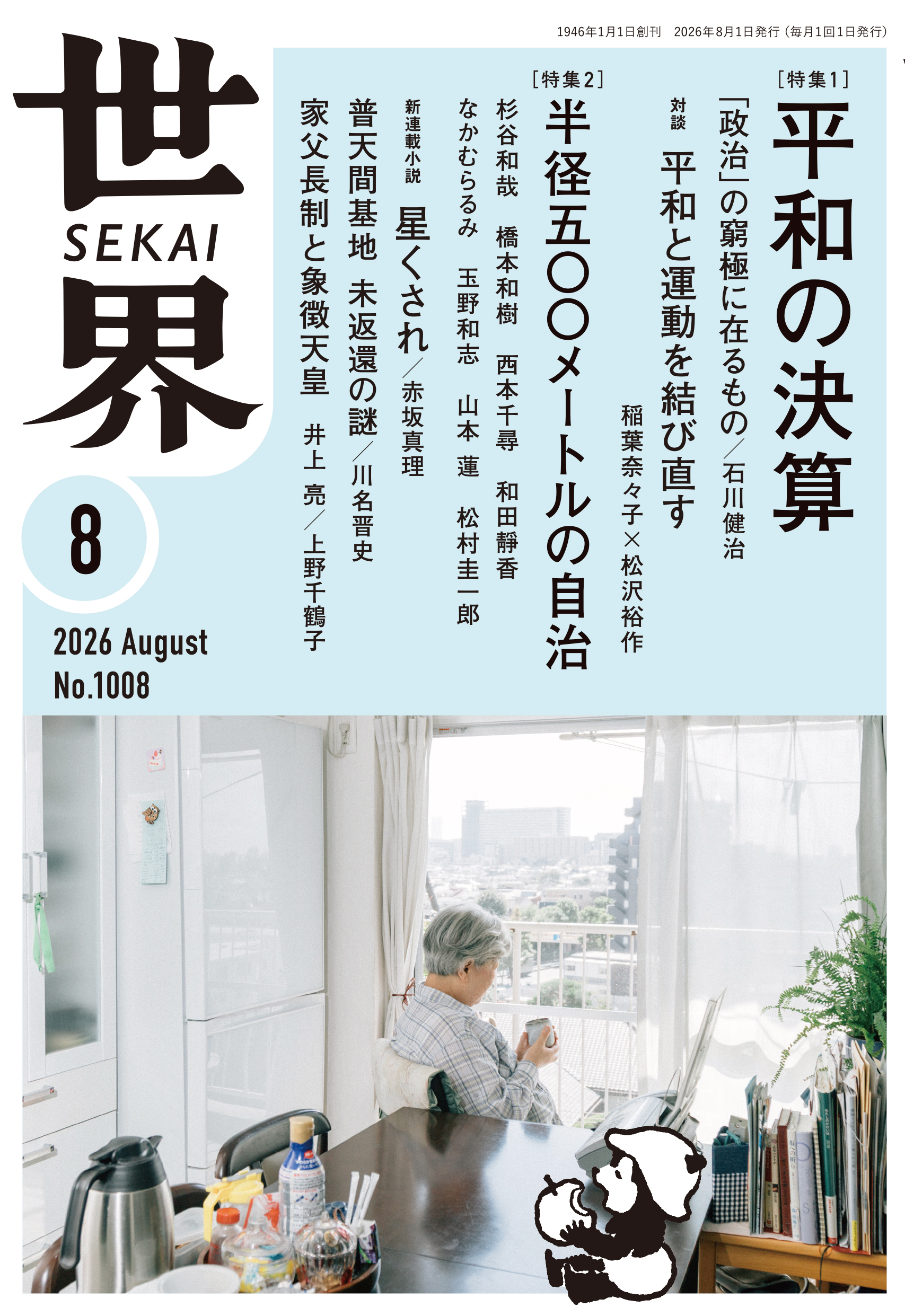
This article is an English translation of Chizuko UENO’s essay “Why I Don’t Welcome a Female Emperor,” originally published in the August 2026 issue of the magazine “Sekai” and made available for free as a special feature on the “Sekai” website (Translator: W-WAN Chizuko HANAOKA). You can read the original Japanese article here.
https://websekai.iwanami.co.jp/posts/9748




![[広告]広告募集中](https://wan.or.jp/assets/front/img/side_ads-call.png)